Mastering the Business Meal Deduction: The Definitive Guide to Tax Savings, IRS Compliance, and Effortless Bookkeeping
Resources:
IRS Publication 463 (Travel, Gift, and Entertainment Expenses)
What it covers: Details the 50% deduction limit for business meals, the rules for overnight business travel meals, the non-deductibility of daily commuting or personal lunches, and the strict substantiation requirements (Amount, Time, Place, Business Purpose, and Business Relationship) under IRC §274(d).
IRS Publication 535 (Business Expenses)
What it covers: Outlines general guidelines for ordinary and necessary business expenses, establishing the baseline distinction between deductible business costs and non-deductible personal living expenses under IRC §262.
Every year, millions of small business owners overpay their federal income taxes by thousands of dollars. The reason is rarely a lack of revenue or an absence of ambition—it is a fundamental misunderstanding of the tax code. Among the most routinely misunderstood and mismanaged areas of small business finance is the humble business meal deduction.
Some entrepreneurs operate under the dangerous assumption that every lunch, coffee run, and solo dining experience can be written off simply because they were thinking about work while eating. On the other end of the spectrum, cautious founders completely avoid claiming legitimate meal expenses out of fear of triggering an IRS audit. Both extremes cost you real capital.
Understanding how the Internal Revenue Service treats business meals is not about hunting for dubious loopholes or playing games with your accounting. It is about establishing clear parameters, executing repeatable workflows, and maintaining structural integrity in your financial backend. When you know the exact rules, you can confidently claim every dollar you earn while remaining completely audit-proof.
Here is the definitive, step-by-step guide to master the business meal deduction, maintain pristine records, and protect your hard-earned profits.
The Core Mechanic: The 50% Rule Demystified
To utilize the meal deduction effectively, you must first understand its foundational rule: Qualifying business meals are generally 50% deductible.
Historically, tax policy surrounding business entertainment and dining has shifted. While temporary legislation occasionally grants 100% deductibility for specific periods (such as the temporary relief measures for restaurant meals during 2021 and 2022), the standard, long-term baseline under federal tax law dictates a 50% allowance for ordinary business meals.
This rule raises a critical question for business owners entering their expenses into accounting software like QuickBooks Online or Wave:
"Does this mean I should only enter half the cost of the meal into my bookkeeping system?"
The answer is an emphatic no.
A fundamental principle of clean bookkeeping is recording financial reality as it happens. If you spend $100 on a qualifying business dinner with a prospective client, your business bank account or credit card experienced a full $100 outflow. Therefore, you must enter the full $100 expense under your "Meals & Entertainment" or "Business Meals" expense account.
Do not manually divide the cost in half when logging the transaction. Attempting to calculate the 50% reduction during day-to-day data entry distorts your financial statements, corrupts your cash flow tracking, and creates a nightmare for your accountant at year-end.
Instead, capture 100% of the cost in your books. When tax season arrives, your CPA or tax preparation software will automatically apply the statutory 50% limit to your total meal account balance when calculating your net taxable income. Your job is simply to record the total outlay accurately and ensure the transaction meets the IRS threshold for qualification.
What Qualifies (And What Fails the IRS Test)
The IRS does not allow write-offs for personal sustenance. Food is a personal living expense under Section 262 of the Internal Revenue Code. For a meal to cross the line from a non-deductible personal expense to a deductible business asset, it must satisfy clear, objective criteria.
1. Client & Partner Meals
Taking a client, vendor, consultant, or strategic partner out for a meal is the classic qualifying scenario. However, simply sitting near a colleague while eating is insufficient.
To qualify:
The meal must be directly associated with the active conduct of your trade or business.
You or an authorized employee of your business must be physically present at the meal.
A substantial, genuine business discussion must take place immediately before, during, or after the meal.
The meal cannot be lavish or extravagant under the circumstances.
Whether you are negotiating a contract over dinner, conducting a quarterly review over lunch, or pitching a new account over coffee, the primary driver of the meeting must be the generation or management of business value.
2. Overnight Business Travel
When you travel away from your "tax home" overnight for business purposes, your meal rules shift slightly.
Because traveling for business forces you away from your normal living routine, the IRS allows you to deduct 50% of your meal expenses incurred during the trip. Crucially, this applies even if you are dining alone.
If you fly to another city for a two-day conference, attend an out-of-state trade show, or visit a remote client overnight, your dinner at the hotel or a local restaurant qualifies for the 50% deduction. The key qualifier is the necessity of overnight rest: a day trip that gets you back home in time for bed generally does not trigger overnight travel status, meaning solo meals on that trip remain non-deductible.
3. What Fails: The Daily Workday Fallacy
One of the most pervasive myths in small business finance is that "if I'm working, my food is deductible."
It is vital to state this clearly: A meal consumed while doing your ordinary daily work does not count.
Buying a latte on your morning commute? Non-deductible.
Ordering takeout to eat at your desk while answering emails? Non-deductible.
Grabbing lunch down the street between regular client appointments in your hometown? Non-deductible.
The IRS views these as personal living expenses. Working hard does not transform routine personal nutrition into a business deduction. Claiming routine personal meals is one of the fastest ways to invite scrutiny during a tax audit.

The IRS Substantiation Standard: Proof vs. Reality
If the IRS selects your business for an audit, the burden of proof rests entirely on you.
Most business owners assume that producing a bank statement or a credit card line item showing a $120 charge at a local bistro is sufficient proof. It is not.
A credit card statement merely proves that money left your account and ended up at a restaurant. It fails to establish why the money was spent, who enjoyed the meal, or what business purpose was served. Under IRC Section 274(d), the IRS enforces strict substantiation rules for meals. Without contemporaneous documentation created at or near the time of the expense, the IRS can—and will—disallow the deduction entirely, assessing back taxes, interest, and penalties.
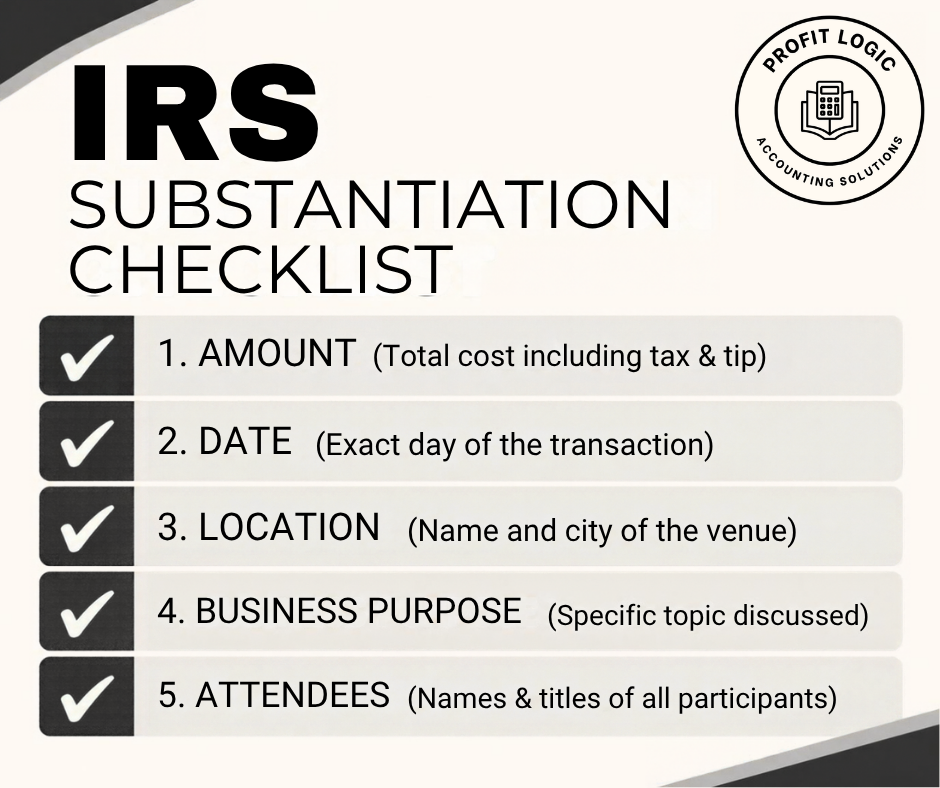
To satisfy the IRS substantiation standard, your records must capture 5 core variables for every business meal:
Amount: The total outlay, including food, beverage, applicable sales tax, and tip.
Date: The exact calendar day the meal took place.
Location: The name and physical city/location of the restaurant or venue.
Business Purpose: The specific nature of the business discussion (e.g., "Reviewed Q4 marketing deliverables," "Initial discovery meeting for prospective software build"). Generic terms like "worked" or "business lunch" are insufficient.
Attendees: The full names, professional titles, and business relationships of everyone present at the table.
The Systemic Fix: Building an Effortless Workflow
Knowing the rules is useless without a frictionless system to enforce them. If you attempt to sort through a shoe box of faded paper receipts once a year every April, you will inevitably lose documentation, forget crucial details, and abandon legitimate deductions out of sheer frustration.
Systematize the process at the point of sale by building a simple, 30-second habit:
Ask for the Itemized Receipt: Always request the detailed, itemized paper receipt showing the specific items ordered—not just the final credit card signature slip.
Note the Metadata Immediately: Physical receipt in hand, take a pen and write two quick details directly at the top: Who was there and What you discussed (e.g., "Sarah Jenkins - Project Proposal").
Capture and Upload Digitally: Open your bookkeeping app (such as QuickBooks Online, Wave, or Expensify) on your smartphone. Snap a clear photo of the annotated receipt.
Match and File: Allow the software to match the receipt image to your auto-synced bank transaction. Once attached, discard the paper receipt. The IRS fully accepts compliant digital images.
By transforming receipt management into a real-time habit rather than an annual chore, you construct an immutable audit trail.
Conclusion: Order Creates Value
Tax strategy is not about aggressive posturing or cutting corners; it is about precision. When you establish clear parameters, execute systematic documentation, and respect the boundaries set by the law, you eliminate tax-time anxiety entirely.
Record the full amount of your expenses, enforce the 5-point documentation standard, limit your write-offs strictly to legitimate client interactions and overnight travel, and let your systems handle the rest. Clear parameters yield effortless tax savings, total peace of mind, and a backend built for lasting scale.